
By Albert & Terra Collver · June 16, 2026
Three weeks old and the Game On litter has discovered two new things this week: their feet, and their opinions. Sound on.
Two weeks ago we wrote that the Game On litter had stopped being a row of small, sightless sausages and started becoming individuals who could see you back. One week later, they can do something even louder about it.
The puppies are three weeks old today — and somewhere in the last seven days, eight English Springer Spaniels who used to communicate entirely by squeaking, kneading, and piling into the nearest warm thing learned to stand up, walk across the box, hear the world, growl at a sibling, and start a fight on purpose. It is, hands-down, the most fun week of a litter's life to watch, and the first week the camera earns its keep.
They're walking now — really walking
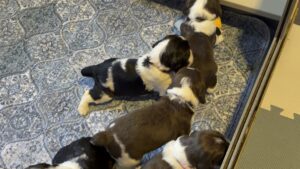
At two weeks these puppies were swimming — that low, paddling, belly-on-the-blanket crawl that gets a newborn from Etta's flank to a warm sibling and not much farther. This week the legs came under them. They are standing, weight-bearing on all four feet, and taking real (if wobbly and slightly drunken) steps. A few of the bigger ones — Purdey and Hunter especially — are already attempting to climb the low front lip of the whelping box, which is our cue that the box's days are numbered and the puppy pen with its larger floor and first novel surfaces is about to go up.
Mobility changes everything. A puppy who can walk can choose — choose to leave the pile, choose to investigate a corner, choose to wander over and bite his brother on the ear. Which brings us to the headline.
They found their voices
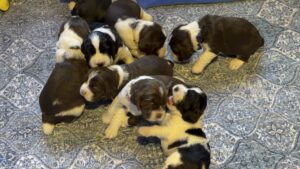
This is the week of the first growls and the first little play-barks, and there is nothing in puppy-raising quite like it. One day the box is full of soft squeaks; the next, there's a tiny, buzzing, completely unconvincing growl coming from a five-week-from-fierce puppy who has decided that the sibling chewing his foot has crossed a line.
There's real developmental machinery behind the comedy. Their ear canals have now opened — ears come online in the week after the eyes, usually Days 14 to 18, and by three weeks the litter is genuinely hearing for the first time. Hearing is what makes vocalizing worthwhile: a puppy who can hear its own growl, and hear a sibling answer it, has just unlocked the entire feedback loop of canine communication. The barks and growls you hear in the video aren't aggression — they're the very first, clumsy reps of social signaling, the language every well-adjusted adult dog uses to say "too rough," "back off," "let's go," and "I'm playing."
It also means this is the week deliberate sound exposure ramps up for us. Now that they can hear, every ordinary household noise becomes a training opportunity — the dishwasher, the doorbell, a dropped pan, the TV, eventually a recording of distant gunfire at a very low volume. The goal is a dog who, years from now, is steady in a busy ring or a noisy field because the world was never quiet enough to be scary.
And the play has started
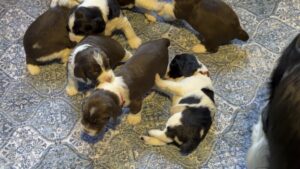
The growling and the walking add up to the third milestone, and the most important one of the three: social play has begun. The puppies are pawing at each other, mouthing each other, pouncing, and rolling into the first proper wrestling matches.
This looks like chaos. It is actually curriculum. Play-fighting between littermates over the next five weeks is how a puppy learns bite inhibition — bite a brother too hard, get a yelp and a quit, learn to soften the mouth — and how it learns to read another dog's signals and offer its own. Puppies removed from the litter too early (before eight weeks) famously miss this window and often grow into dogs that are mouthy, socially clumsy, or quick to escalate. It is one of the central reasons our puppies go home at eight weeks and not a day sooner. The wrestling in that video is, quietly, some of the most valuable education these dogs will ever receive — and the only teachers qualified to give it are the seven siblings in the box with them.
The bodies behind the noise: Day 21 weights
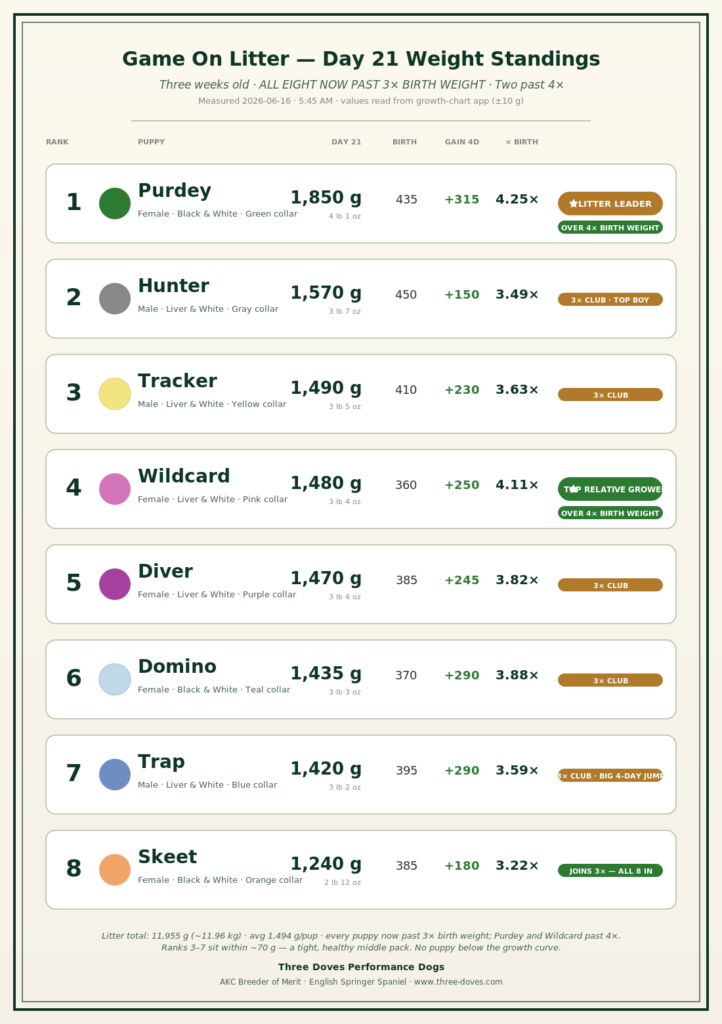
Three weeks of Etta's milk has produced a strong, even litter. As of this morning's weigh-in, the litter totals roughly 11.96 kilograms — call it twenty-six pounds of English Springer Spaniel where, twenty-one days ago, there were about three and a half. The headlines from the scale:
- Every puppy in the litter is now past 3× its birth weight. Skeet, our steady little caboose, was the last one in.
- Purdey (4.25×) and Wildcard (4.11×) have crossed 4×. Purdey remains the unambiguous size leader; Wildcard — born the smallest puppy in the box at 360 grams — is the litter's top relative grower, which is a lovely thing to watch in a puppy who started behind.
- The middle of the pack is tight — five puppies within about seventy grams of each other — which is exactly what you want to see. No puppy is lagging the growth curve; the whole litter is thriving in lockstep.
- By the numbers: Etta has produced an estimated 25–30 liters of milk — close to 7–8 gallons, or more than half her own body weight — in just three weeks. That's the fuel behind 8.8 kilograms of puppy growth (a 3.2 kg litter at birth is now nearly 12 kg). It's also why she's on three meals a day plus a bedtime snack and still losing condition. Every gram on that weight chart came from her.
What this means if you're waiting on one of these puppies
For the families watching from a distance: this is the week your puppy stopped being an infant and became a small dog with a personality you'll eventually recognize. The temperament we'll formally measure with the Volhard test in mid-July is starting to hint at itself now — who barrels in, who hangs back and watches, who's the loudest, who's the peacemaker. We're taking notes, and those notes feed directly into how we match puppies to homes.
It's also the week the real socialization work begins in earnest. Puppy Culture's "Week of Wow" — the structured push of novel surfaces, objects, sounds, and textures — kicks off right around Day 21 and runs hard for the next two weeks. Now that the puppies can walk, see, and hear, they're finally equipped to experience novelty rather than just sleep through it.
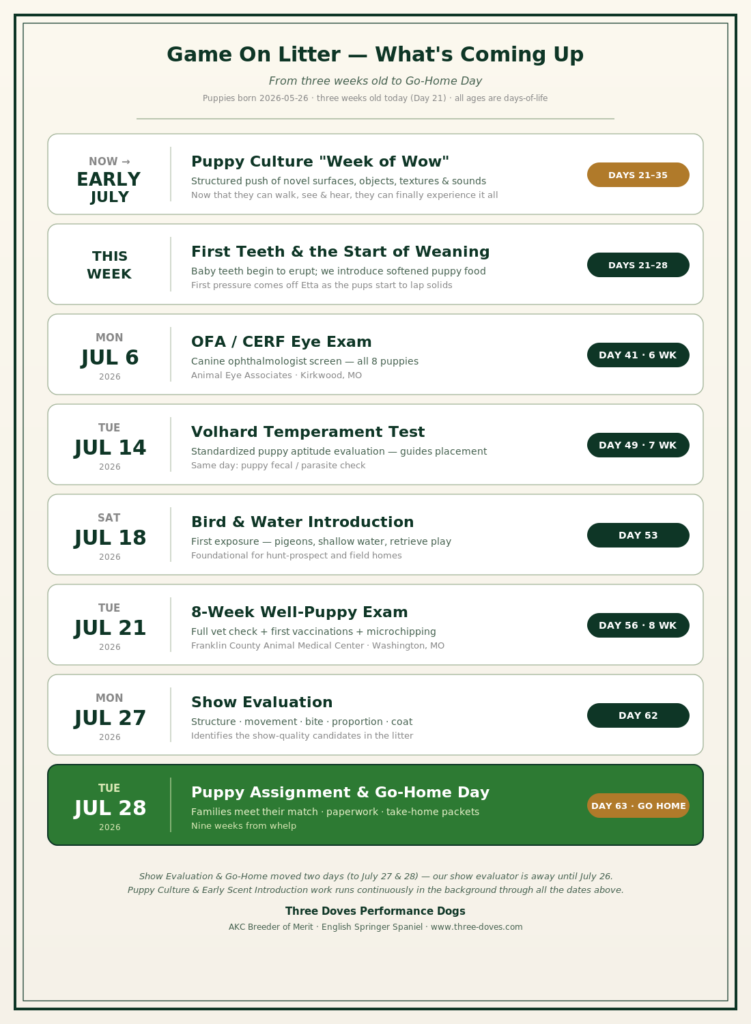
What's coming up
One more from the hardest worker in the room
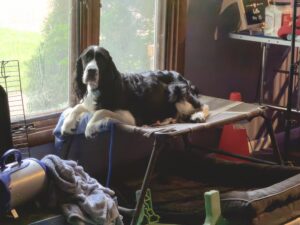
And these days, when the box finally goes quiet, you'll find her up on her perch. There's a raised cot by the window, and Etta has claimed it — front paws draped over the edge, the morning light coming in off the trees behind her, eight full and sleeping puppies in a heap on the floor below. For three weeks she has been down in that pile every two hours, the warm center of everything, never more than an inch from a hungry mouth. Now that the puppies can settle themselves, she allows herself this: a few feet of elevation, a patch of sun, and a long, level look out the window while her litter rests. She still has an ear cocked toward them — she always will — but for the length of one nap, she is just a dog on a sunny bed again, and she has earned every minute of it. When you meet your puppy in late July, look for her. She'll be the one keeping watch from up high.
She raised eight quiet sausages into eight loud little dogs in twenty-one days. As always: when you collect your puppy in late July, thank Etta first.
We'll keep the camera rolling.
— Albert & Terra
