
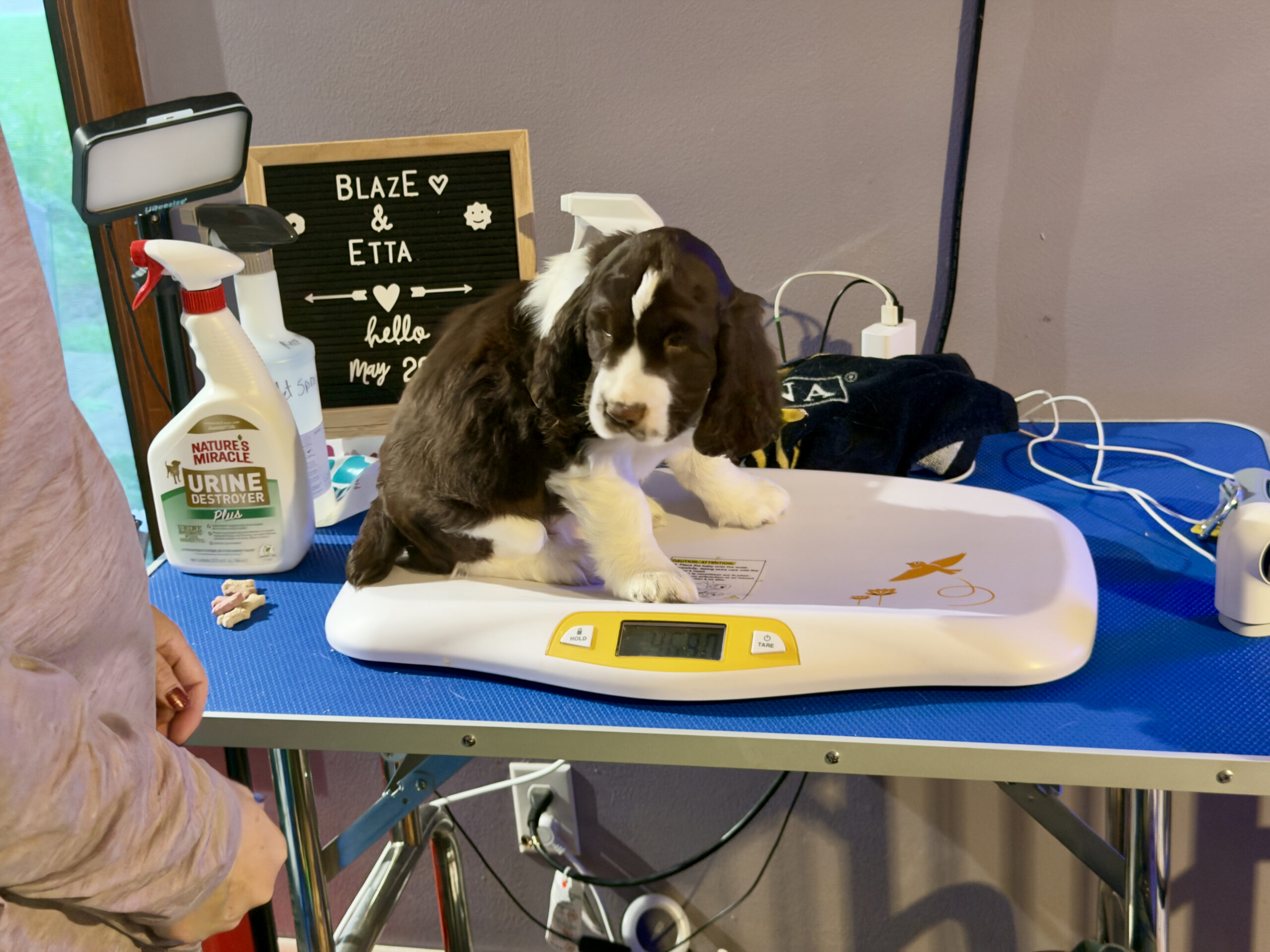
The Game On litter turned seven weeks old today, and of all the milestones between whelping and go-home, this is the one we circle on the calendar. Seven weeks — 49 days — is the week a puppy’s brain finishes wiring itself into an adult’s, the week their true temperament becomes readable, and the week the door swings wide open on the single most important learning window of their entire life. It’s also, not coincidentally, the week we run formal temperament testing and take the puppies out to meet their first bird. Here’s what’s happening inside these eight puppies right now, what we’re watching for, and why the timing matters so much.
The scale: a litter leader pulls away
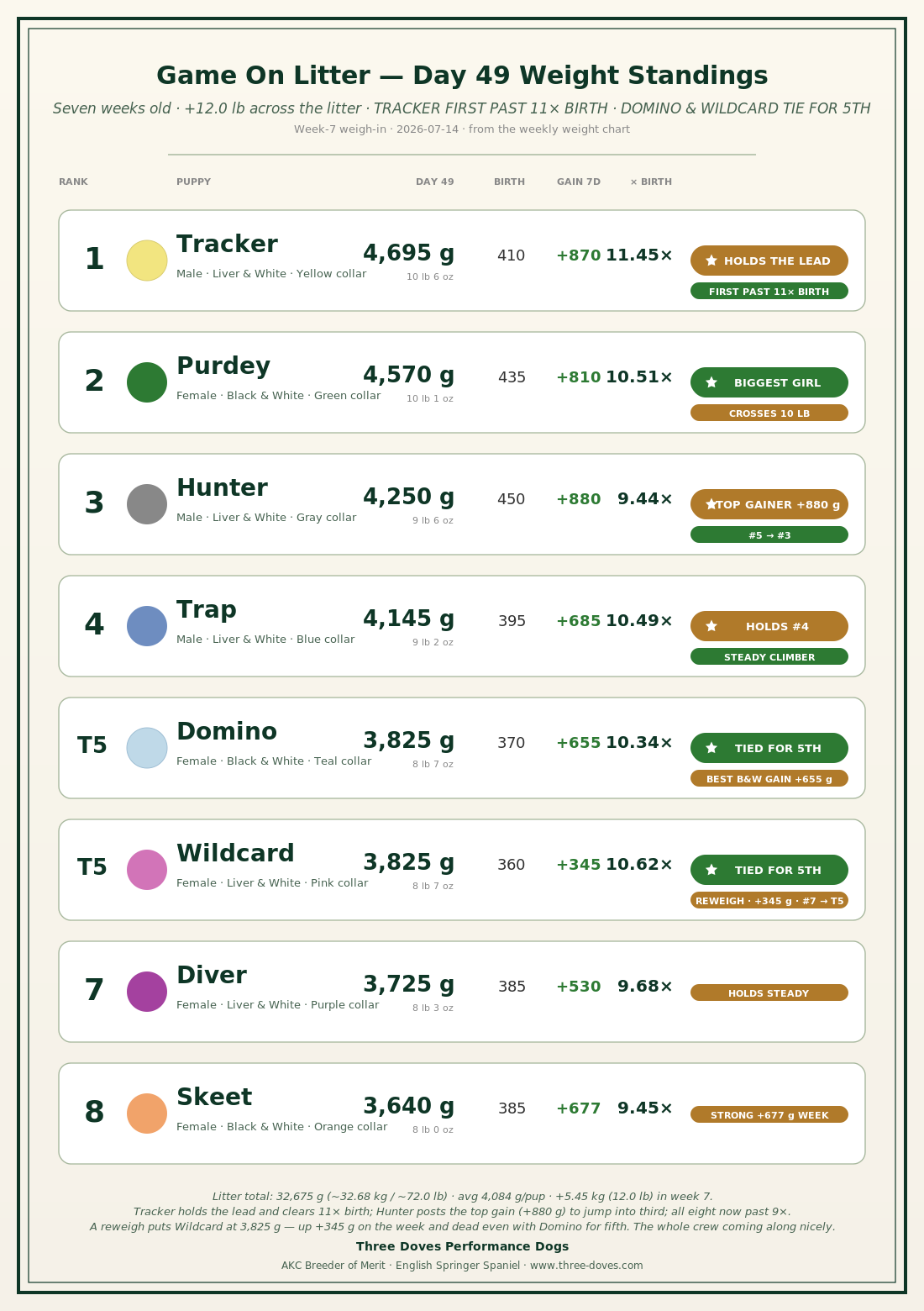
Seven weeks of good eating adds up. The litter now totals about 32.7 kilograms — roughly 72 pounds of English Springer Spaniel — after another +5.45 kg (12.0 lb) put on this week, averaging just over 4 kg (9 lb) per puppy. A few standings notes:
- Tracker holds the lead and is pulling away. The yellow-collar boy tops the litter at 4,695 g (10 lb 6 oz) and became the first puppy past 11× his birth weight — a remarkable run for a pup who was the fifth-heaviest at birth.
- Purdey stays right behind at 4,570 g (10 lb 1 oz), the first girl to cross 10 pounds and still the biggest female in the litter.
- Hunter posted the top gain of the week at +880 g, vaulting from #5 all the way to #3 — the heaviest-born puppy reminding everyone he’s still here.
- A dead-even tie for fifth: Domino and Wildcard both land at exactly 3,825 g. Wildcard — born the smallest puppy in the litter at 360 grams — now sits at 10.6× her birth weight, still the top relative grower of the whole group.
- All eight puppies are now past 9× their birth weight, with the whole crew coming along nicely.
Yellow collar: meet Tracker
The yellow collar belongs to Tracker, a liver-and-white male and, at the moment, the pace-setter of the whole litter. He was born fifth of eight in the small hours of May 26 at 410 grams and has climbed steadily to the top of the standings. Beyond the numbers, he’s exactly the kind of confident, engaged, into-everything puppy you love to see at this age — which brings us to what seven weeks is really about.
What a seven-week-old puppy is going through
Somewhere around the 49th day, a puppy’s brain waves become indistinguishable from an adult dog’s. The neurological hardware is finished; from here on it’s all software. That single fact is why so much of what we do is timed to this exact window.
Socially, the litter is running a full-time classroom. Over the past couple of weeks the puppies have shifted from simply piling together to genuinely playing with one another — stalking, pouncing, wrestling, chasing, and the endless mouthing that looks like chaos but is actually the most important curriculum of their lives. Through that play they’re learning bite inhibition (a littermate yelps and the game stops, teaching them to soften their jaws), the give-and-take of social rank, and the basic grammar of being a dog. Etta and the puppies themselves are the teachers here, and it’s a big part of why a puppy should never leave its litter before eight weeks — these are lessons that are very hard to teach after the fact.
Emotionally, they’re bold, curious, and resilient — right now. This is the heart of the critical socialization period (roughly weeks 3 through 12, peaking right about now), the stretch when a puppy is neurologically primed to accept new people, surfaces, sounds, and experiences as normal. A puppy who meets the world kindly during these weeks tends to grow into a confident adult. Just ahead of them, around eight to eleven weeks, comes the fear-imprint period, when startling experiences can leave an outsized mark. That’s precisely why seven weeks is the sweet spot for new experiences: the puppies are at their most open and their most bounce-back-able, and we want to bank as many good, confident first impressions as we can before that more sensitive window arrives.
Physically, they’re fully equipped. Eyes and ears have been working for weeks, they’re weaned onto solid food, and they run, pounce, bark, and problem-solve with real coordination. They can hold a scent, follow a moving object, and recover from a startle in seconds. Everything they need to be tested — and to start meeting the world — is now online.
Temperament testing: today
That timing is exactly why our Volhard temperament tests happen today, on Day 49. It’s not an accident of the calendar. The Volhard Puppy Aptitude Test is designed to be run at seven weeks precisely because the brain is now an adult’s, so the puppy’s innate temperament shows through clearly — before layers of learned habit start to cover it up.
Each puppy is taken individually, by someone they don’t know, into a neutral space, and gently walked through a series of short exercises: how readily they come to a person, whether they follow, how they respond to being gently restrained or lifted, their reaction to a sudden sound and — importantly — how quickly they recover from it, and their interest in chasing and retrieving. We’re not looking for a “pass” or “fail.” We’re reading each puppy’s natural tendencies: bold or cautious, independent or people-focused, soft or busy, high drive or easygoing. That profile is one of the most valuable tools we have for matching the right puppy to the right home — a driven, into-everything pup like Tracker thrives in a very different household than a gentler, more sensitive littermate. Combined with everything we’ve observed living with these puppies day and night, the test helps make sure each family goes home with the puppy that actually fits their life.
First birds: later this week
Then, on Saturday, comes one of the most fun days of the whole program: the puppies’ first introduction to birds (paired with their first water). Our dogs are bench-bred Springers, but the bird is written deep in the breed, and we love watching it wake up. This isn’t field training — it’s a gentle, low-pressure first meeting. We let each puppy encounter a bird wing and bird scent on their own terms and simply watch what happens: the head that snaps around, the nose that locks on, the little body that creeps forward with sudden purpose. Some puppies light up instantly; others take a curious sniff and file it away. There’s no wrong answer, and nothing is forced. It’s an experience, an observation, and — timed right in the middle of that confident socialization window — a wonderful first impression of something this breed was built to love.
What to look for at seven weeks
If you’re bringing home a puppy soon, this is a great age to understand, because what you see now is a real preview of the adult dog. A few things we watch for, and that you can watch for too:
- Recovery, more than reaction. Every healthy puppy startles at a new sound. What matters is how fast they shake it off and get curious again — quick recovery is the hallmark of a resilient temperament.
- People-orientation. Does the puppy choose to come to a person, follow them, and check in? That social pull toward humans is one of the best predictors of an easy-to-live-with adult.
- Curiosity over caution. At seven weeks you want to see a puppy investigate new objects and surfaces rather than avoid them.
- Play style. Watching how a puppy plays with littermates — pushy, gentle, persistent, or easygoing — tells you a lot about the personality coming down the road.
None of these is a grade. Taken together, they’re a portrait — and drawing that portrait, for all eight puppies, is what this week is for.
The home stretch
Seven weeks old, temperament tested, and about to meet their first birds. From here the calendar moves quickly: an eight-week wellness exam and vaccinations next week, show evaluation the week after, and then go-home day on Tuesday, July 28. These are the puppies’ last couple of weeks as a litter, and they’re spending them exactly the way we’d hope — confident, curious, and busy meeting the world.
As always: when you collect your puppy, thank Etta first.
— Albert & Terra
Three Doves Performance Dogs — AKC Breeder of Merit, English Springer Spaniel
www.three-doves.com · info@three-doves.com · 636-751-3971
