By Albert & Terra Collver · July 15, 2026
A couple of weeks ago we wrote about the biggest day of health work the Game On litter will have before they go home — the day all eight puppies were microchipped, gave a DNA sample, and were examined by a veterinary eye specialist. At the time we were still waiting on the lab. This week the last of the paperwork came back, and we can finally share the whole picture.
Here is the short version, eight puppies across:
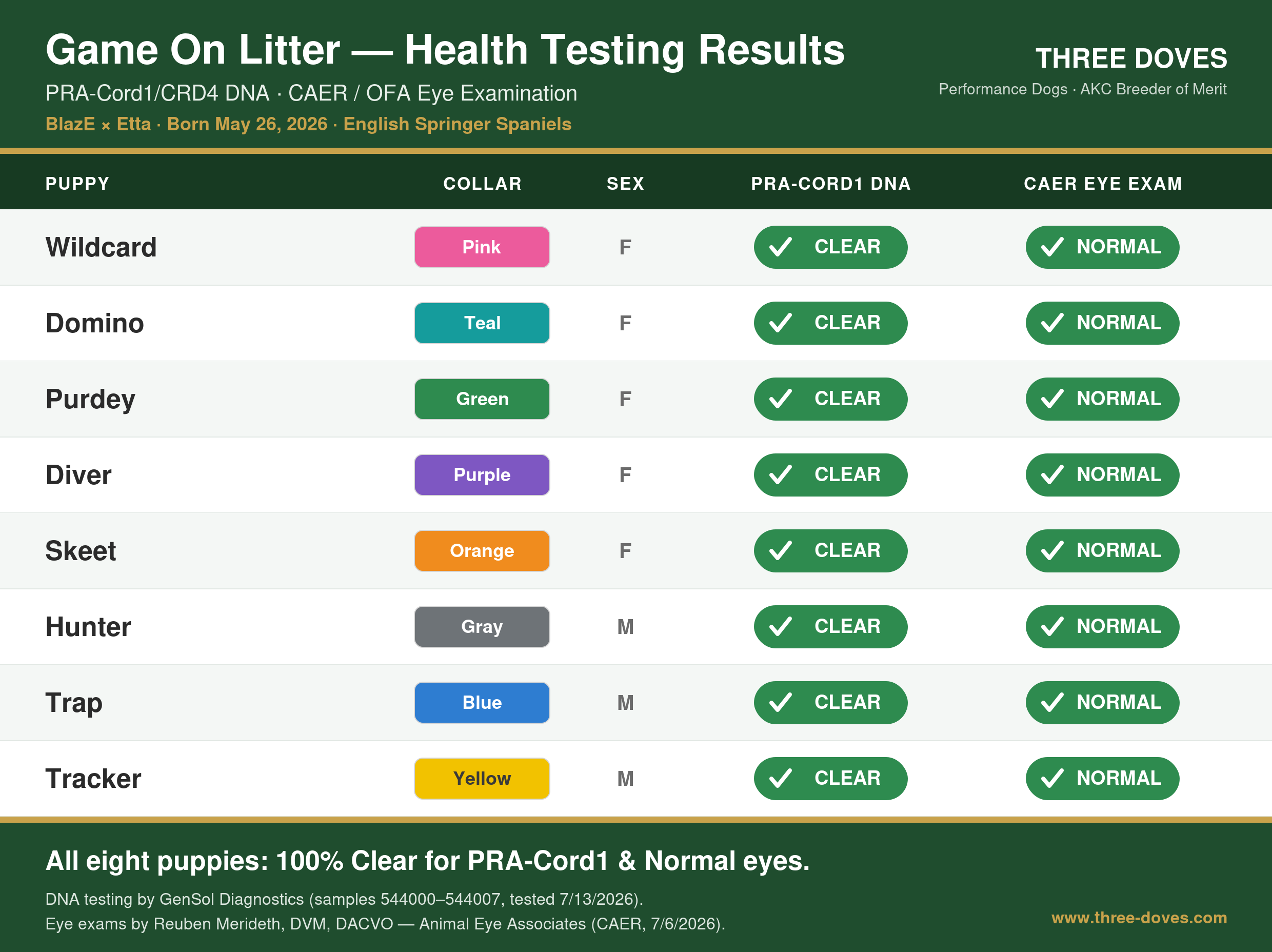
Every puppy in the litter is Clear on the PRA-Cord1 DNA test and Normal on the CAER eye exam. Two completely different tests, checking two completely different things, and all eight came through both.
That’s the headline. But the numbers don’t mean much unless you know what the two tests actually are — and, just as important, what breeders and families had to live with before these tests existed. So let us walk through it.
First, why eyes get their own day
Vision is not something a dog gets a second chance on. English Springer Spaniels are a wonderful, healthy breed, but like every purebred dog they carry a handful of known eye conditions in the gene pool. Some are inherited through a single gene you can now test for with a cheek swab. Others are physical or structural problems that no DNA test can see, and can only be found by a specialist looking into the eye itself. Because those are two different kinds of problem, it takes two different tests to rule them both out. We do both, and we do them while the puppies are still here, so that every family leaves with proof rather than a promise.
The DNA test: PRA-Cord1 (CRD4)
PRA stands for progressive retinal atrophy — a family of inherited diseases in which the light-sensing cells at the back of the eye slowly die off. There is no treatment and no cure. A dog with the disease gradually loses sight, usually ending in total blindness. The cord1 form (also written crd4/cord1, tied to a gene called RPGRIP1) is the variety that turns up in Springers.
Here is the part that makes it so dangerous: it is recessive. A puppy has to inherit two copies of the mutation — one from each parent — to actually go blind. A dog with just one copy is a “carrier”: it has perfectly normal eyes, lives a perfectly normal life, and shows absolutely no sign of the gene it’s carrying. You cannot see it. You cannot exam your way to it. Two healthy, bright-eyed carriers bred together can, and do, produce puppies that lose their sight.
What this looked like before the DNA test existed
For most of the history of purebred dogs, breeders were flying blind on this — literally. Progressive retinal atrophy has been recognized for roughly a century, but until recent decades the only way to detect it was to wait and watch. A breeder would raise a litter, place the puppies, and then, months or years later, get the heartbreaking phone call: a young dog was bumping into furniture in dim light, then losing its sight entirely. By the time the disease revealed itself, that dog — and often several of its relatives — had frequently already been bred, quietly passing the same hidden gene into the next generation. Careful breeders did everything right by the knowledge they had: they studied pedigrees, they had annual eye exams done, they retired affected lines the moment problems appeared. But they were always one step behind a gene they had no way to see.
That changed in the mid-2000s, when researchers identified the specific RPGRIP1 mutation behind cord1 and turned it into a simple, affordable DNA test. For the first time, a breeder could know a dog’s status before breeding it — Clear, Carrier, or Affected — from a swab, not from a tragedy. It is genuinely one of the most important tools to arrive in this breed in our lifetimes. It doesn’t just protect individual puppies; used honestly, it can push a disease like this out of a line for good.
That’s why we send every puppy’s DNA to the lab (GenSol Diagnostics, in this case) and hand you the certificate at go-home. A “Clear” result means your puppy carries two normal copies of the gene and will not develop PRA-Cord1. It also tells anyone thinking about breeding down the road exactly what they’re working with.
The eye exam: CAER
DNA covers the genetic risk. But genes are not the whole eye. So on that same clinic day, every puppy was examined by a board-certified veterinary ophthalmologist — Dr. Reuben Merideth, DACVO, of Animal Eye Associates — for a hands-on CAER exam.
CAER stands for Companion Animal Eye Registry, run through the Orthopedic Foundation for Animals (OFA). Older breeders will remember it by its previous name, CERF (the Canine Eye Registration Foundation); the registry moved to OFA and became CAER in 2012, but it’s the same idea and the same rigorous exam. The ophthalmologist dilates each puppy’s eyes and, under magnification, checks the whole eye — lids, cornea, lens, and retina — for physical, structural, and developmental problems that a DNA test simply cannot catch.
In Springers, that checklist is worth taking seriously: retinal dysplasia (folds or detachment in the retina), juvenile cataracts, distichiasis (stray eyelashes that rub against the eye), persistent pupillary membranes, and other early faults all appear in the breed and can affect a dog’s vision or comfort for life. Before this kind of specialist screening was routine and available, these conditions were often caught only when an owner noticed something wrong — a cloudy lens, a squinting or weepy eye, a dog that couldn’t see well in the dark — long after a puppy was placed or a dog was bred. The exam catches them early, on a healthy puppy, before any of that.
Dr. Merideth examined all eight puppies and marked the same word on every form: Normal.
Why it takes both
Think of it as two nets with different-sized holes. The DNA test catches an invisible genetic time bomb that a physical exam would sail right past — a carrier’s eyes look flawless. The CAER exam catches physical and developmental problems that no single-gene DNA test is looking for. Run only one, and things slip through. Run both, and you’ve checked a puppy’s eyes from the genetic code all the way out to the retina. Clear DNA and a Normal exam is the complete picture — and that’s what all eight of these puppies have.
What this means if one of these puppies is coming home to you
It means the eye-health questions are already answered, in writing, before you ever load a crate into your car. Your puppy’s certificate will show its own PRA-Cord1 result, and its CAER exam is on record with OFA. You are not taking our word for it and you are not hoping for the best; you’re starting a fifteen-year friendship with a dog whose eyes have been checked, twice, by two independent methods, and cleared both times.
This is the same standard we hold BlazE and Etta to as parents. Now it belongs to their puppies, too.
The other half of a sound start: the Volhard temperament test
Clear eyes tell you a puppy can see the world. They don’t tell you who that puppy is. So this week, at seven weeks old, all eight puppies also sat for a Volhard Puppy Aptitude Test (PAT) — the temperament evaluation that helps us match the right puppy to the right home.
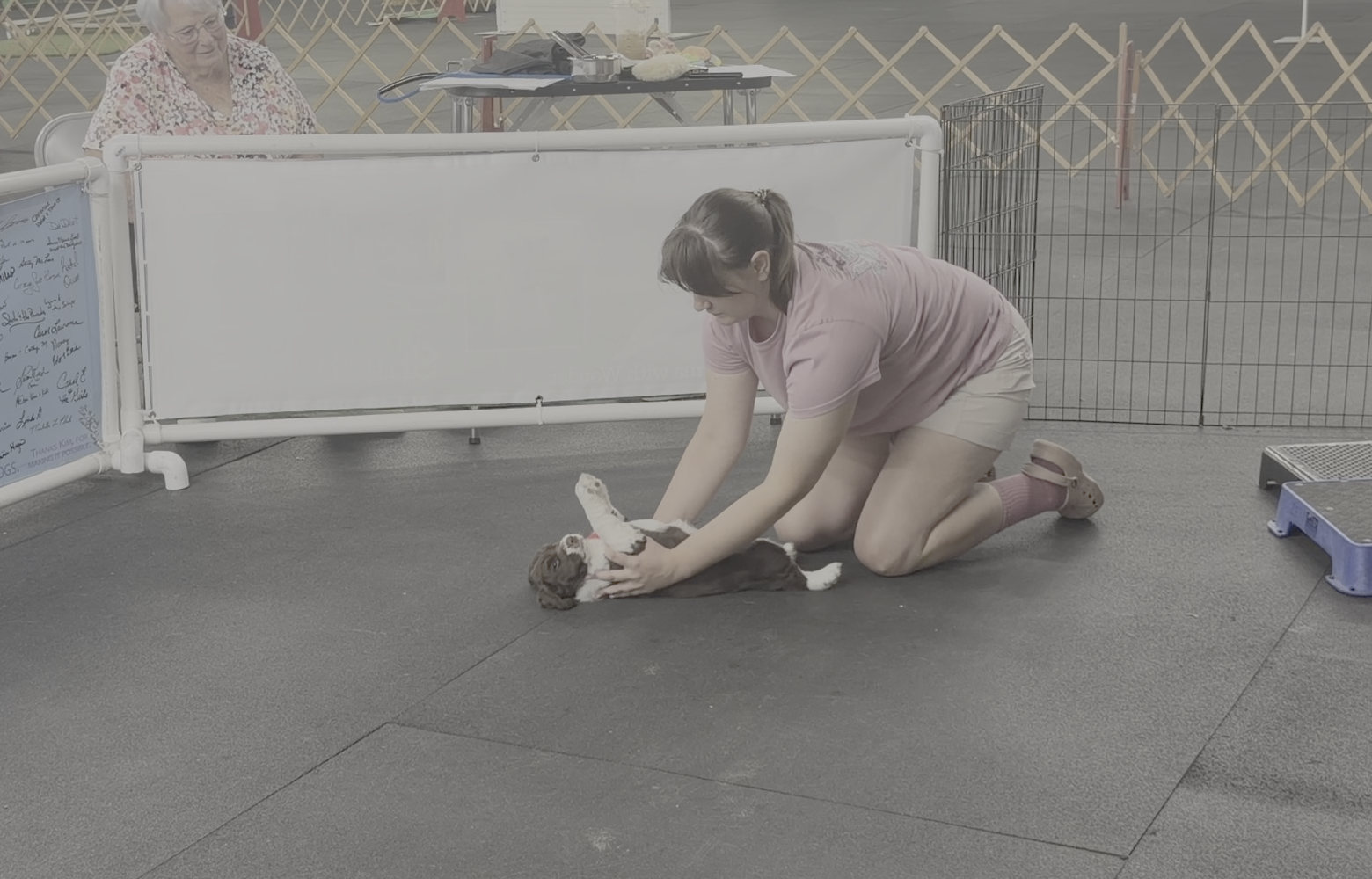
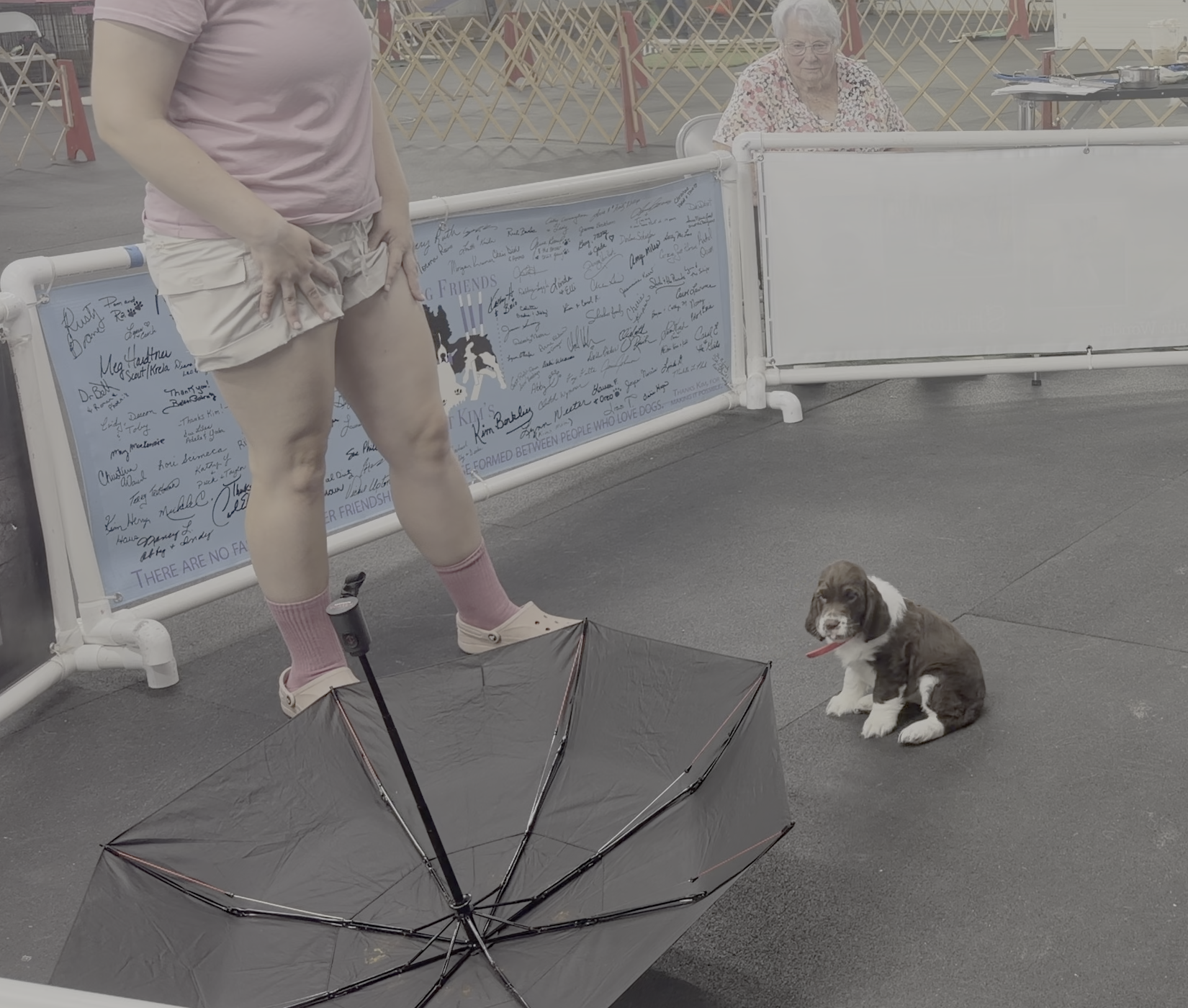
A quick word on what that is, because it’s easy to picture something more mysterious than it actually is. The test was developed by Wendy and Jack Volhard and has been used by breeders and trainers for decades. It’s a series of ten short exercises, and the timing is deliberate: right around 49 days of age, a puppy’s brain has developed enough to show its natural tendencies, but it hasn’t yet been shaped much by training or experience — a genuine window into temperament. To keep it honest, the puppies are taken one at a time to an unfamiliar place and worked by a neutral tester the puppies have never met, not by us. A breeder scoring her own puppies on her own floor isn’t really testing anything. Ours were evaluated at a training club by an experienced tester, with a separate scorer writing everything down.
The ten exercises look at things like social attraction (does the puppy come to a stranger?), following, restraint, acceptance of handling, retrieving, and sensitivity to touch, sound, and sudden sights. Each is scored on a 1-to-6 scale. Here’s the important part: it is not a pass/fail and it is not a grade. A “1” isn’t better than a “6”; they simply describe different tendencies — a bolder, more dominant puppy versus a softer, more sensitive one. The whole point is fit. A high-drive, forward puppy may be a wonderful sport or performance prospect and a poor match for a quiet retirement home; a gentle, sensitive puppy may be the perfect family companion and easily overwhelmed by a chaotic one. And because a single test day is only a snapshot — puppies get tired, a strange room is a strange room — we weigh it alongside everything else we know from living with these puppies every day.
Here are three of the exercises in action (that’s Wildcard, our Pink-collar girl):
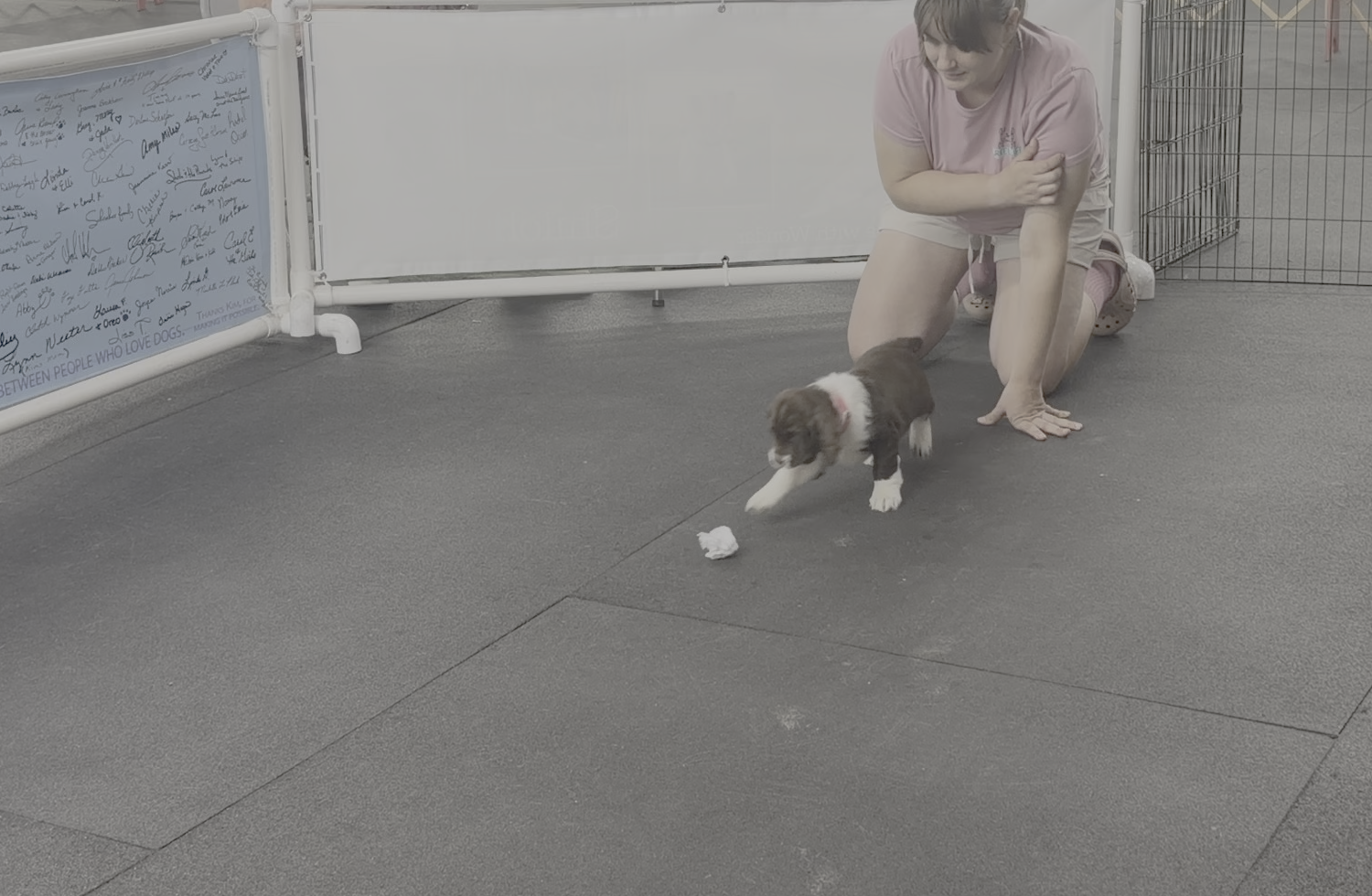
Tomorrow, we’ll go puppy by puppy — how each of the eight did, what kind of personality is starting to show, and the sort of home each one is built for. This post is the health side; tomorrow is the personality side.
Eight puppies. Clear DNA, clear exams, healthy normal eyes, and a full temperament picture on every one. That’s a very good couple of weeks.
As always: when you collect your puppy later this month, thank Etta first.
— Albert & Terra
Three Doves Performance Dogs — AKC Breeder of Merit, English Springer Spaniel
www.three-doves.com · info@three-doves.com · 636-751-3971
