
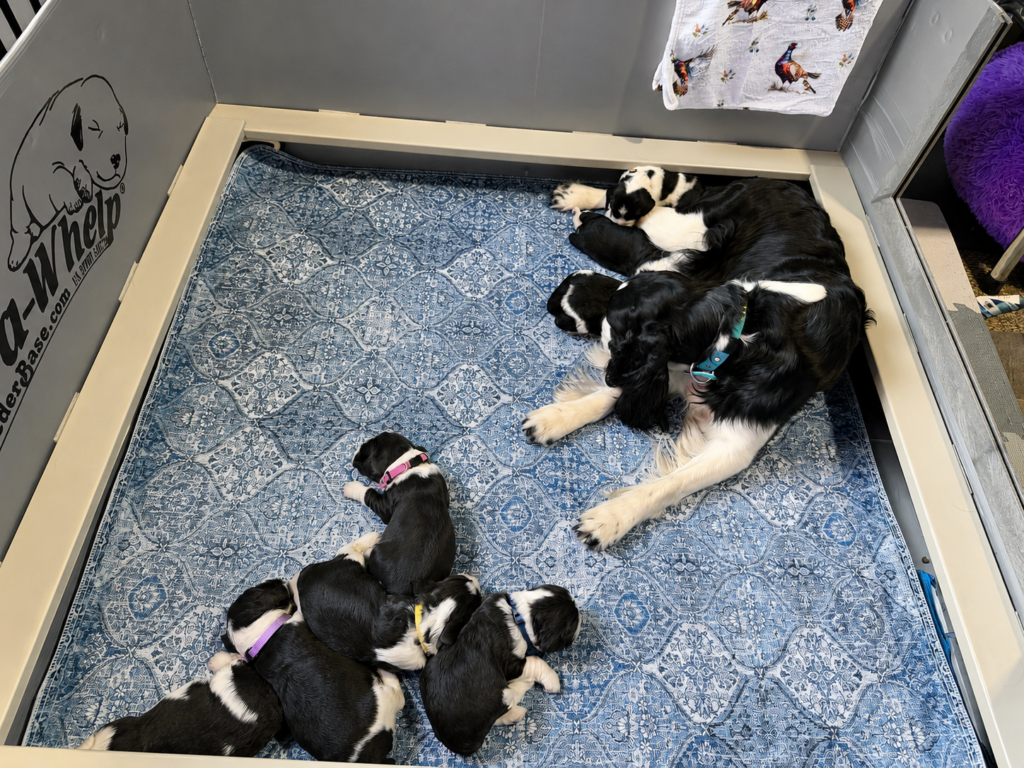
A small mystery on Day 16 of the Game On litter, and an honest "we don't know what to make of it yet" — which we think is the right place to start when something unusual shows up.
For the last two mornings, when we walk in to do the daily weigh-in and ENS work, the three black-and-white puppies in the litter — Purdey, Domino, and Skeet — have been piled together in one corner of the whelping box, separately from their five liver-and-white siblings. The L/W puppies — Hunter, Tracker, Trap, Wildcard, and Diver — pile near Etta in the opposite corner. The black-and-white cluster is on its own, off doing whatever it is they are doing.
This is the kind of observation we usually shrug off the first time we see it. By the second morning, we started taking pictures.
What we actually saw
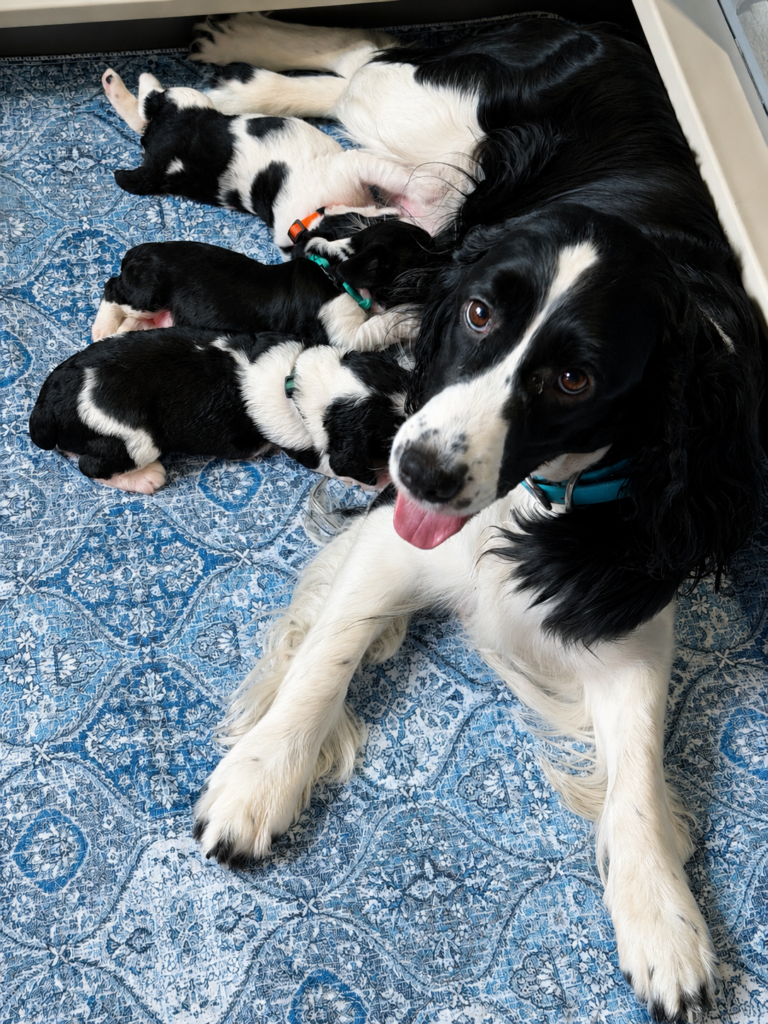
Both clusters are tight. The three B/W puppies are touching, often piled on top of each other. The five L/W puppies are in a separate pile, and they are the ones who are physically against Etta — nursing, sleeping with paws on her, kneading her belly. The B/W puppies are not with Etta. They have, in essence, voluntarily walked away from the source of milk and warmth and gone to lie in a corner with each other.
For context: these puppies are sixteen days old. Their eyes opened between Days 13 and 14 (all eight are now visually online), and their ear canals are starting to open this week. They are coordinated enough to crawl with intent, but a long way from walking. This isn't an accident — they're crawling several puppy-lengths to get to each other, which at this age is real effort.
The boring explanation we have to mention first
Before we get to the fun theories, an honest piece of math.
There are only eight puppies in this litter — three black-and-white and five liver-and-white. The number of ways to pick exactly three puppies out of eight is 56. The number of those combinations that happen to be "the three B/W ones" is exactly 1. So the prior probability of three randomly-sorted puppies all being the same color is about 1.8% — uncommon, but not astronomically so. We could be looking at coincidence, repeated for two days, and that would be that.
That said: when something looks like a coincidence twice in a row, on two consecutive mornings, with the same three puppies in the same configuration, we tend to want to investigate before we wave it off.
A few theories, in increasing order of "interesting"
Theory 1: Nipple territory. Newborn puppies tend to establish preferred nursing positions in the first few days of life — a particular nipple on Etta's belly, in a particular sequence in the queue. If Purdey, Domino, and Skeet happened to take adjacent positions in the nursing order, they would have spent two weeks lying side-by-side every two hours. By Day 16, that's a lot of accumulated tactile bonding. They may simply be the puppies who learned each other's bodies before they learned the L/W puppies' bodies.
This is the explanation that requires zero genetic novelty and that most experienced breeders would point to first. It's almost certainly part of what we're seeing.
Theory 2: Scent matching. Puppies have functional olfaction at birth, and there is reasonable research that puppies can distinguish their own littermates by scent very early on. Coat color genetics in the Springer is controlled by the TYRP1 locus — the same gene that produces the liver pigment also affects some downstream skin chemistry. It would not be biologically absurd if liver-pigmented and black-pigmented puppies smelled subtly different to each other.
We don't know of a study that has demonstrated this in dogs specifically. But it's not a crazy hypothesis.
Theory 3: Visual preference now that eyes are open. This is the theory we find most intriguing, partly because the timing fits. The three B/W puppies started clustering around Day 14, which is roughly when their eyes finished opening and they could see each other for the first time. Etta herself is a black-and-white dog. The three B/W puppies look like Etta. The five L/W puppies do not.
If a newly-sighted puppy's earliest visual concept is "things-that-look-like-mom-are-safe," then a black-and-white puppy's first sight of another black-and-white puppy might trigger a small spike of "you are familiar" recognition that a liver-and-white sibling would not. This is the breeder version of a phenomenon that is well-documented in human infants — that babies preferentially orient toward faces that resemble their primary caregiver — but it is wildly speculative when applied to two-week-old puppies.
Theory 4: Temperature. Sometimes the most boring explanation is right. The corner where the B/W puppies have piled up may simply be a warmer (or cooler) micro-zone of the whelping box, and they happened to find it first. Puppies are extremely sensitive to ambient temperature at this age, and a one- or two-degree difference in the box matters to them more than it matters to us.
What we're going to do about it
What you do with an observation like this is — almost nothing, immediately. You note it. You take the pictures. You write down which puppies clustered with whom, on which day, in which configuration. You keep watching to see whether it persists, whether it dissolves once Puppy Culture's Week of Wow exposures begin in five days, and whether the same pattern shows up in Aster's planned fall litter (which will be all liver-and-white, conveniently, and therefore will not have the color contrast that makes this observation possible).
In the meantime, the boring nipple-territory theory is the one we'd bet money on. But we are leaving the door open for the visual-preference theory because the timing of the clustering — right after the eyes finished opening — is suspicious enough to make us pay attention.
If you've ever seen something like this in a litter of any breed, we'd love to hear about it. Drop us a note in the comments below, on our Facebook page, or in the private buyers' group. Breeder-to-breeder anecdote is how a lot of observations like this eventually become real questions worth studying.
— Albert & Terra
